
Artificial intelligence now powers a majority of global market transactions, raising fears that automated trading systems could trigger the next financial meltdown. While headlines warn of machine-driven crashes, leading analysts argue the real risk lies in human overconfidence, excessive leverage, and weak safeguards. This in-depth report examines expert opinions, real market events, and what investors should realistically expect next.
Introduction: Why This Question Is Suddenly Everywhere
A decade ago, artificial intelligence in finance was mostly invisible. Today, it sits at the very heart of global markets.
From Wall Street trading floors to retirement funds quietly compounding in the background, AI systems now decide when to buy, when to sell, how much risk to take, and how fast to move. For everyday investors, this shift has sparked a wave of anxiety that shows up clearly in search trends:
- “Will AI crash the stock market?”
- “Is algorithmic trading dangerous?”
- “Can AI trigger a financial crisis?”
These are no longer fringe concerns. According to industry estimates, more than two-thirds of daily US equity trading volume is now executed by algorithms, many of which rely on machine learning rather than fixed rules.
That level of automation raises a serious question:
If machines react faster than humans, could they panic faster too?
The fear is understandable. Financial history is filled with moments when new technology promised efficiency but delivered instability when poorly understood or misused. Yet history also shows that markets evolve, adapt, and survive.
This article cuts through the hype to answer one core question honestly and clearly:
Is an AI-driven market meltdown imminent—or are we misunderstanding the real risks?
What People Mean When They Say “AI-Driven Market Meltdown”
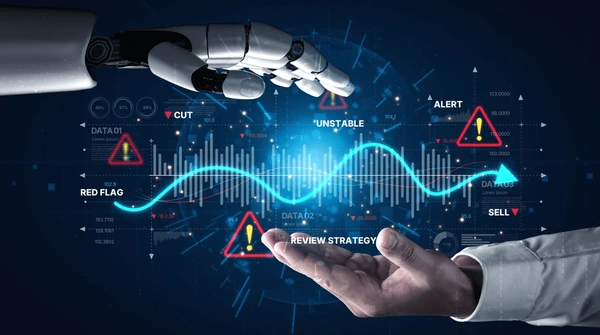
An AI-driven meltdown does not mean machines suddenly turning hostile or “deciding” to crash the economy.
Instead, it refers to a systemic failure scenario where:
- AI-powered trading systems react to the same signals simultaneously
- Automated selling overwhelms available liquidity
- Feedback loops amplify minor shocks into major price swings
- Human intervention arrives too late to slow the cascade
In other words, the danger is not intelligence—it’s speed, synchronization, and scale.
A Simple Real-World Analogy
Imagine a packed airport terminal. One traveler starts running, believing they heard an emergency announcement. Others see the movement and run too. Within seconds, panic spreads—even if there was no real danger.
AI systems can behave similarly in markets. They don’t panic emotionally, but they react identically, which can create the same outcome.
How AI Became Central to Modern Financial Markets
AI’s dominance did not happen overnight. It emerged through a steady evolution driven by competitive pressure and technological progress.
Three Forces Behind AI’s Rise
- Data Explosion
Markets now generate massive streams of data—earnings reports, economic releases, news headlines, social media sentiment, and real-time price movements. - Computing Power
Tasks that once required supercomputers can now be performed cheaply in the cloud, allowing even mid-sized firms to deploy sophisticated models. - Relentless Competition
In markets where milliseconds matter, firms that adopted AI early gained measurable advantages. Others had no choice but to follow.
Today, AI systems do far more than place trades. They are used to:
- Forecast earnings surprises
- Detect momentum shifts
- Allocate assets dynamically
- Manage portfolio risk
- Identify arbitrage opportunities
These capabilities have improved efficiency—but they have also made markets more interconnected and complex.
Are Markets More Fragile Because of AI?
This is where expert opinion sharply divides.
The Argument That AI Increases Fragility
Some analysts warn that AI may reduce diversity in decision-making. Many models are trained on similar historical datasets and optimized for similar outcomes.
That can lead to:
- Herd-like behavior at machine speed
- Over-confidence in historical patterns
- Blind spots during unprecedented events
- Sudden liquidity withdrawal during stress
When everyone uses similar tools, markets can appear stable—until they are not.
The Counterargument: AI Improves Stability
Other experts argue the opposite. They believe AI:
- Detects risks earlier than humans
- Removes emotional bias from decisions
- Adjusts portfolios continuously rather than abruptly
- Identifies inefficiencies that humans miss
They point out a critical fact: despite massive AI adoption, markets have endured pandemics, inflation shocks, rate hikes, and geopolitical crises without systemic collapse.
Lessons From Real Market Events That Fuel Today’s Fear
The Flash Crash: A Cautionary Tale
In May 2010, US markets plunged nearly 1,000 points within minutes, only to recover shortly afterward. Investigations later showed that automated trading interactions played a major role.
Although modern AI is far more advanced, the event demonstrated how speed and automation can magnify instability when safeguards are inadequate.
Crypto Markets: A Live Experiment
Cryptocurrency markets offer a modern glimpse into automated chaos.
During major sell-offs:
- AI bots trigger stop-loss cascades
- Margin calls force liquidations
- Algorithms amplify downward momentum
Traditional markets are better regulated, but the underlying dynamics are strikingly similar.
Are Today’s AI Systems Truly “Smart”?
One of the most dangerous misconceptions is that AI understands markets.
It does not.
AI systems:
- Recognize patterns, not meaning
- Extrapolate from historical data
- Struggle with truly novel events
This matters because financial crises are, by nature, rare and unprecedented.
For example, many AI models trained during decades of low inflation struggled when inflation surged suddenly. Some funds suffered losses not because AI failed—but because it had never seen such conditions before.
The Questions Americans Are Asking Right Now—Answered Clearly
Will AI Cause the Next Stock Market Crash?
Highly unlikely on its own.
Crashes typically require a toxic mix of:
- Excessive leverage
- Asset bubbles
- Economic stress
- Policy mistakes
AI can accelerate a downturn, but it rarely creates one from nothing.
Can AI Trading Systems Panic the Market?
Yes—under specific conditions.
If multiple systems interpret the same data as a sell signal, they may:
- Sell simultaneously
- Drain liquidity
- Exaggerate price movements
This risk is highest during crisis moments or low-liquidity periods.
Are Humans Still in Control?
Humans design the systems, set the rules, and monitor outcomes—but machines execute faster than humans can react.
That gap explains why modern markets rely on:
- Circuit breakers
- Kill switches
- Mandatory human oversight
What Top Analysts Actually Agree On
Despite headline differences, a quiet consensus is emerging:
- AI is not an existential threat to markets
- Poor governance is the real danger
- Transparency and stress-testing matter more than intelligence
As one strategist put it:
“AI doesn’t create risk. It reveals and amplifies the risk already there.”
Where the Real Risks Are—and Where They Aren’t
Legitimate Concerns
- Over-reliance on similar models
- Reduced market diversity
- Blind trust in black-box systems
- Speed overwhelming human controls
Overstated Fears
- AI intentionally crashing markets
- Fully autonomous systems without oversight
- Inevitable collapse due to automation
Markets have survived computers, the internet, high-frequency trading, and globalization. AI is another evolution—not a death sentence.
What This Means for Everyday Investors
You don’t need to understand machine learning to invest wisely in an AI-driven market.
You need discipline.
Practical Takeaways
- Stay diversified across asset classes
- Focus on long-term fundamentals
- Avoid panic selling during volatility
- Understand your personal risk tolerance
- Ignore sensational AI headlines
What to Avoid
- Trying to outtrade algorithms
- Chasing short-term signals
- Assuming markets are “rigged”
- Overreacting to every technology scare
Are Regulators Prepared for AI Risk?
Regulation is catching up.
Current safeguards include:
- Mandatory stress testing
- Trading speed limits
- Market-wide circuit breakers
- Real-time surveillance tools
No system is perfect, but modern markets are far better protected than in the past.
Final Verdict: Is an AI-Driven Market Meltdown Imminent?
Based on expert analysis, historical data, and real-world evidence:
No—an AI-driven market meltdown is not imminent.
However:
- AI can worsen volatility during crises
- Weak oversight increases risk
- Investors must adapt to faster markets
Markets don’t collapse because of tools. They collapse because of human behavior, leverage, and misplaced confidence. AI simply reflects those forces at unprecedented speed.
Understanding that distinction is the key to investing calmly in the age of intelligent machines.
Frequently Asked Questions (10 Trending FAQs)
1. Is AI trading dangerous for the stock market?
AI trading increases speed and efficiency but can amplify volatility if poorly regulated.
2. Could AI cause another financial crisis?
AI could intensify an existing crisis but is unlikely to cause one alone.
3. Are AI trading systems regulated?
Yes, especially in US equity markets, though regulations continue to evolve.
4. Do hedge funds rely heavily on AI?
Many use AI as a support tool rather than a full replacement for human judgment.
5. Can retail investors compete with AI?
Retail investors succeed by focusing on long-term strategies, not speed.
6. Does AI make markets unfair?
AI changes market dynamics but does not eliminate opportunity.
7. Are index funds affected by AI trading?
Indirectly, but index investing remains one of the most stable approaches.
8. What happens if AI systems fail simultaneously?
Circuit breakers and human intervention are designed to prevent collapse.
9. Is AI risk higher during recessions?
Yes, stress periods expose model weaknesses more clearly.
10. Should investors avoid AI-influenced markets?
Avoiding innovation is rarely wise—understanding it is better.