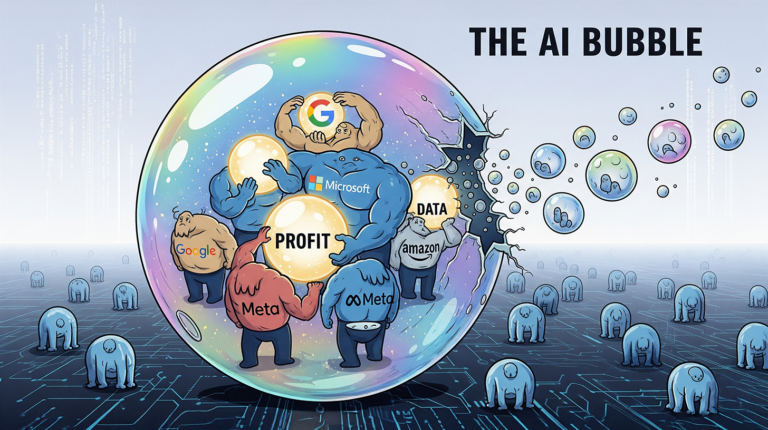
The explosive growth of artificial intelligence has triggered unprecedented investor enthusiasm, inflating valuations for both mega-cap tech giants and speculative small-cap firms. While core leaders like Nvidia, Microsoft, and Amazon continue generating real revenue from AI, hundreds of other companies are riding hype alone. This article examines how AI mania is forming the next major stock market bubble—and reveals which companies are genuinely safe for long-term investors.
Introduction
Artificial intelligence has become the most powerful economic catalyst of the decade. Everywhere you look—corporations, Wall Street, government agencies, retail investors—people are pouring money, time, and attention into AI-powered solutions. The technology is real, transformative, and capable of redefining industries in ways we’ve never seen.
But alongside its massive potential lies a more uncomfortable truth: AI mania is also fueling the next big stock market bubble, and millions of Americans may not recognize the warning signs soon enough.
Just like the dot-com boom in the late 1990s, excitement is turning into obsession. Companies are rebranding themselves as “AI leaders,” investors are chasing parabolic moves out of fear of missing out, and valuations are skyrocketing far faster than revenue growth can justify.
And yet, not all AI stocks are created equal. A handful of companies—the true infrastructure, cloud, and semiconductor giants—are well positioned to thrive whether the bubble bursts or not. Knowing the difference is what separates smart investors from those who get caught in the hype.
In this long-form guide, we break down why AI mania is creating a bubble, the real-world warning signs, the safest companies in the space, and how investors can protect themselves without abandoning the AI revolution.
Why AI Is Creating a New Stock Market Bubble
AI is not just another emerging technology. It’s a foundational shift similar to the rise of the internet, smartphones, and cloud computing. But unlike previous tech waves, AI’s adoption rate is exponentially faster.
This speed is the problem.
Here’s what’s fueling the bubble-like environment.
1. Unrealistic Growth Expectations
In many AI-related stocks, investors are pricing in decade-long 40%–60% annual revenue growth, even though no large-scale industry in history has sustained those rates for long.
Some small-cap AI companies double in valuation overnight after announcing vague “AI expansion plans,” despite having:
- No clear monetization model
- Flat or declining revenue
- Increasing losses
- Minimal R&D capability
A recent example includes a mid-tier enterprise software firm skyrocketing 100% in a week simply because it added “AI-powered insights” to its product description—without showing a single live demo.
2. FOMO Among Retail Investors
The average American investor fears missing “the next Nvidia.” Social media accelerates this with daily lists like:
- “Top 5 AI stocks under $10”
- “AI penny stocks that will explode”
- “Next Nvidia everyone is sleeping on”
These posts rarely mention financials, profitability, or long-term sustainability. The focus is simple: hype.
Platforms like TikTok, X, and YouTube are major drivers of emotional investing, creating crowd-fueled rallies with little substance behind them.
3. Rebranding for Hype and Attention
History is repeating itself.
- In 1999, companies added “.com” to their names.
- In 2017, they added “blockchain.”
- In 2023–2025, companies are adding “AI-powered,” “AI-enabled,” or “AI-integrated.”
One public company achieved its largest price surge in years solely because its ticker symbol is literally AI. Analysts highlighted that revenue had stagnated, yet investors rushed in because the name implied leadership.

4. Record-Breaking Venture Capital Spending
VC firms are pouring billions into AI startups, often at valuations that defy logic. According to Crunchbase, more than $29 billion flowed into AI startups in the first half of 2024 alone. Some startups with minimal revenue are reaching billion-dollar valuations based purely on potential.
This inflow builds pressure on public markets, driving up valuations for any company remotely connected to AI technology.
5. Analysts Amplifying Unrealistic Narratives
Investment banks are issuing ever-higher price targets stating AI could add $15 trillion to the global economy by 2030. While these projections might be directionally correct, they often gloss over a crucial point:
Only a small fraction of companies will capture the majority of this value.
Most will fade into irrelevance once competition intensifies or technology shifts.
How Today’s AI Boom Compares to the Dot-Com Bubble
The similarities are striking—but there are differences too.
| Category | Dot-Com Era | AI Mania Era |
| Companies with no revenue | Extremely high | Lower but rising fast |
| Rebranding to attract investors | Common | Increasingly common |
| Extreme valuation multiples | Yes | Yes, especially in small/mid caps |
| Tangible utility | Limited early on | Immediate and profound |
| Survivors after crash | <5% | Likely similar |
The biggest difference?
AI has real, immediate productivity value. But markets are treating every AI-related company as if they’ll be the next trillion-dollar winner.
They won’t.
Warning Signs the AI Market Is Overheating
Investors should watch for these red flags:
- Companies mention “AI” more than they discuss revenue or strategy
- Valuation-to-revenue ratios explode past 25x–40x
- CEOs promote “future AI monetization” with no product
- Meme-stock-style trading behavior begins
- Insider stock selling follows high-profile AI press releases
- Startups claim to build custom AI chips but have no fabrication partnerships
Real-life example:
Recently, a tiny hardware manufacturer claimed it was “developing proprietary AI chips,” sending shares up nearly 700% in days. Analysts later confirmed the company manufactured basic consumer electronics with no semiconductor capabilities.
Which AI Companies Are Truly Safe?
While many speculative AI stocks are dangerously overvalued, certain companies remain fundamentally strong, financially sound, and structurally essential.
These companies form the backbone of the AI ecosystem—and will likely thrive for decades, bubble or not.
1. Nvidia — The Engine of the AI Revolution
Nvidia is the unmatched leader in GPU-based AI acceleration. Nearly every major AI model, including ChatGPT, Gemini, Claude, and Llama, relies on Nvidia’s chips.
Why Nvidia is safe:
- Dominates market share (80%+)
- Expanding into AI software stacks
- Huge demand backlog extending into 2026
- High margins + strong ecosystem stickiness
Nvidia is less a chipset vendor and more an AI infrastructure giant.
2. Microsoft — The Enterprise AI Powerhouse
Microsoft’s partnership with OpenAI puts it at the center of both consumer and enterprise AI growth.
Safe because:
- Massive cloud revenue base
- Microsoft 365 Copilot adoption growing fast
- Deep enterprise integration
- Strong data advantage across Windows, Azure, and Office
Real example:
Corporations adopting Copilot report ~29% productivity gains in internal testing.
3. Amazon — AI + Cloud + Automation
Amazon quietly remains one of the strongest AI plays through AWS, its AI-first logistics, and custom silicon.
Why it’s safe:
- AWS remains the world’s largest cloud
- Amazon’s custom chips reduce dependency on Nvidia
- E-commerce and logistics gain efficiency from AI automation
- Diversified revenue streams
4. Alphabet (Google) — The AI Research Core
Google invented many of the foundational technologies used in modern AI.
Safe due to:
- Largest data advantage in the world
- Gemini LLM integrating across Search and Workspace
- Long-term research leadership
- Cloud AI expanding rapidly
5. ASML & Broadcom — The Picks-and-Shovels Winners
These companies profit no matter who wins the AI model race.
ASML builds the machines required to manufacture advanced chips.
Broadcom powers networking, chips, and data infrastructure.
Both are essential, irreplaceable, and structurally safe.
Which AI Companies Are Most at Risk?
High-risk companies include:
- Pre-revenue AI startups
- Firms reliant on a single enterprise customer
- Public companies whose “AI product” is rebranded legacy software
- Micro-cap stocks pumping on hype
- AI companies with long-term negative gross margins
- Businesses announcing AI partnerships without technical demonstrations
Example:
One AI startup IPO’d at a $3 billion valuation but later revealed its “AI platform” relied on third-party models with no proprietary innovation. Shares plunged 40% in weeks.
Is the AI Boom Sustainable?
The answer: Yes—but not at current hype levels.
Sustainable factors:
- Corporate AI adoption accelerating rapidly
- Genuine productivity gains
- Huge capital investment in chips, data centers, and cloud infrastructure
- Strong demand across nearly every industry
Unsustainable factors:
- Overpriced small-cap stocks
- Rebranding hype
- Meme-driven price behavior
- Companies chasing investor money instead of product development
AI as a technology will survive—and dominate—but many AI stocks will not.
How Investors Can Protect Themselves During the AI Bubble
Practical takeaways:
- Favor companies with real revenue and cash flow
- Avoid firms with unclear AI strategies
- Study revenue per employee to evaluate efficiency
- Stick to category leaders (chips, cloud, enterprise software)
- Use AI-focused ETFs for safer diversification
- Never buy a stock solely because it has “AI” in its name
- Be cautious of parabolic moves caused by social sentiment
Smart investors don’t avoid innovation—they avoid hype.

Top 10 FAQ About the AI Stock Market Bubble
1. Is the AI stock market in a bubble right now?
Yes, selectively. The mega-caps are expensive but stable; speculative AI companies are at bubble-like valuations.
2. Will AI stocks crash in 2025 or 2026?
A correction is likely, especially among small caps, but the long-term AI trend remains strong.
3. What are the safest AI stocks today?
Nvidia, Microsoft, Alphabet, Amazon, ASML, and Broadcom are the strongest.
4. Is Nvidia overvalued?
It’s richly valued but supported by real revenue, unmatched demand, and extreme competitive advantage.
5. Should I invest in cheap AI stocks?
Be careful. Most cheap AI stocks are speculative or lack true competitive advantages.
6. Will AI eliminate jobs?
Goldman Sachs estimates AI could impact 300 million jobs globally, increasing corporate profits over time.
7. Are AI ETFs safer?
Yes. They reduce exposure to individual company failures and spread risk across the industry.
8. What industries will benefit most from AI?
Healthcare, retail, finance, cybersecurity, logistics, and semiconductor manufacturing.
9. What’s the biggest investing risk today?
Overpaying for hype-based companies posing as AI innovators.
10. How long will the AI boom last?
Likely a decade or more, but stock valuations will fluctuate significantly.